Choosing 3TOON as a partner means choosing a committed producer. Sincerity is a key element of storytelling, and a brand must beware of the backlash tied to communication that is not perceived as sincere and authentic.
Given the importance of the content-production partner on this level, it is essential to measure the risks of entrusting production to a “mercenary”, ready to change values with every contract.
The choice of producer should be guided by a search for coherence. Coherence between the partner’s various productions, but also coherence between the values of the brand and those of the studio entrusted with the production.
Basic premise: audiovisual content has a real impact on the viewer
It is a fact regularly denied. Yet the content of programmes has an impact on viewers’ vision of the world, and on their behaviour. Scriptwriters therefore carry a responsibility that goes well beyond what the concept of artistic freedom might suggest.
It is not we who say or decree it. These are the conclusions of a multitude of scientific studies demonstrating the impact of media on mentalities and actions (see the references below).




The 4 philosophical pillars of 3TOON
All productions signed 3TOON follow an editorial line built on fundamental values. Here they are, briefly described.
 Positivity
 Positivity
Positivity is a mental attitude that can be described as constant optimism in the face of life. Far from being a blissful acceptance of whatever happens, it is a way of thinking that makes it possible to identify solutions and potential benefits, whatever the level of stress and difficulty one may encounter.
Harmony
 Harmony
Human beings are social animals who only find meaning in life through their exchanges with others. Harmony allows these exchanges to satisfy everyone by reconciling self-interest with the pursuit of the common good. The solutions it reveals often bring a greater benefit to all.
Kaizen (continuous improvement)
 Kaizen (continuous improvement)
From the Japanese, the expression Kaizen can be translated as “continuous improvement”. It is in fact a mindset that leads each of us to analyse what we do in order to improve it. A constant attitude that is never satisfied with the status quo, and aims for unattainable perfection.
Contribution
 Contribution
In the evening of life, it is the feeling of having improved things around us that gives the most value to the existence we have lived. Knowing in advance the importance of contribution, each of us can build a life that serves the lives of others as well as possible — and find, in the end, our own fulfilment there.
A few examples produced by 3TOON
The few examples below will let you appreciate the concrete way 3TOON breathes these values into the programmes produced by the studio. They are sometimes obvious, as in the examples with a clearly educational vocation. On other occasions they appear far more subtly and discreetly, in productions such as the web series “1 minute de pause” or the game “Titanic”.
Showcasing sustainable development with “1 minute de pause”
 Among 3TOON’s productions, the animated web series “1 minute de pause” holds a special place: it is the first application of an idea that had long been germinating in the founders’ minds — convincing brands in search of respectful communication to become creative partners for ambitious entertainment programmes with an ethical dimension.
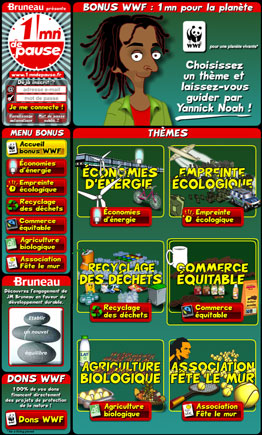 The idea took shape as the third season of the series produced with JM Bruneau, designed as a gift to its customers. Themes dear to the company (and to 3TOON), such as sustainable development, organic farming and fair trade, are subtly showcased throughout the episodes.
Among the deliberately caricatural, flaw-ridden characters, the assistant (Martine) stands out by embodying the positive values (solution-oriented thinking, benevolence, respect for the environment) — and she is, in practice, the one who keeps the detective agency running.
The scriptwriters’ mission is to ensure that weaving in these values has no negative impact on the quality of the programme; the primary objective remains, above all, to deliver funny, light-hearted cartoons.
 This showcasing of ecological values nevertheless led the WWF to associate itself with the series, and helped the founders convince Yannick Noah to become a voice actor for his own animated character. France’s “favourite personality” agreed to play along because the series and its green message convinced him to join the adventure.
Teaching waste sorting with “The Hidden Treasure of the Dustbin”
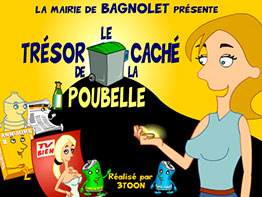 This cartoon is intended to explain the benefits of selective waste sorting, both for citizens and for local authorities.
Produced with the support of the CNC (France’s national film agency), the film is aimed primarily at local authorities (town councils, groups of municipalities, county councils…) wishing to raise young audiences’ awareness of waste issues — selective sorting in particular — in a playful way.
This civic-themed cartoon demonstrates that sorting has a positive impact not only on the environment, but also contributes to the creation of new products, new wealth and new jobs. To sort is to prove that you care about the planet’s future. The cartoon also conveys the message that it takes very little to acquire good new habits — which brings in the Kaizen theme, with the idea of continuous improvement (of one’s own behaviour).
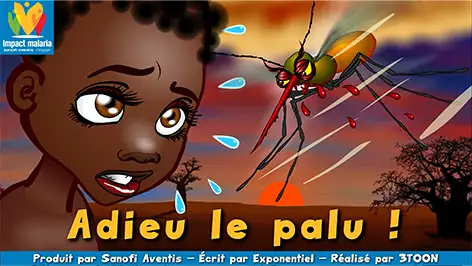
Health prevention with “Adieu le palu!” (Farewell, Malaria!)
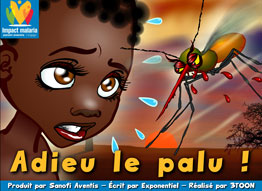 3TOON is honoured to have put its know-how to work on this malaria-prevention message. Unlike most of our other productions, humour was not the vehicle chosen here, but the combination of two other dramatic devices: fear (of the mosquito) and courage, embodied by the character of the little sister.
Positivity, harmony and kaizen are the values present in this cartoon. Positivity: nothing is inevitable; solutions can always be found, even to the gravest and most persistent problems. Harmony: harmony begins with oneself, by taking care of one’s body and protecting it. Kaizen: learning to change a habit, replacing it with a more effective, more positive one (here, using a mosquito net from nightfall).
Commissioned by the pharmaceutical company Sanofi Aventis, the programme is aimed at young African audiences, with the ambition of instilling a few elementary, effective notions in the fight against the scourge of malaria — which still causes the death of one child every 30 seconds…
Health prevention with the multimedia programme “Chers plaisirs”
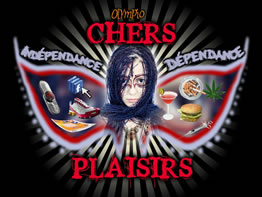 Produced for the Olympio association, the multimedia programme “Chers plaisirs” aims to raise teenagers’ awareness of the various risks of addiction (with subtlety, without lecturing). Some addictions spring to mind immediately, such as alcohol or tobacco; others are less obvious, such as addiction to fashion or social networks.
The health hazard is not the same for all of them, but in every case, the social disruption can be quite significant once the addiction takes hold.
Positivity shows here in the refusal to be overwhelmed by difficulties, and in accepting to acknowledge them — the indispensable first step towards finding solutions. Harmony, once again, begins with oneself, by respecting the integrity of one’s own body. Accepting that approach, and committing to it, is the very spirit of kaizen.
Saving lives with the game “Titanic: Rescue Mission”
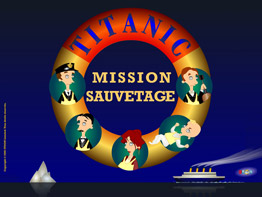
The game “Titanic: Rescue Mission” is a rare example on the Internet, because the players’ motivation is to save lives — whereas for the immense majority of games available on the Web, the objective is to destroy, kill or conquer…
This atypical aspect in no way hinders the success of the game, which is played 350,000 times a year by enthusiastic players who share their scores, screenshots included, in online discussion forums (entirely independent of 3TOON).
Positivity (courage), harmony (respect for the lives of others, benevolence) and contribution (generosity, mutual aid) are the values woven into this game.
References on the impact of media
The scientific literature on media influence is particularly abundant — and remarkably consistent. To make a first contact easier, here is a brief selection of bibliographic references (in French).
The synthesis note by the IRSIC, entitled “L’influence des programmes télévisuels violents sur les enfants et les adultes” (The influence of violent television programmes on children and adults), offers a synthesis of the main research available in 2010. It can be read in PDF format at the following link: https://www.3toon.com/documents/violence_des_medias.pdf
The report by the SRED, entitled “Les enfants et la télévision – résultats et tendances de la recherche” (Children and television — research results and trends), is based on a survey of 223 bibliographic references. It can be read in PDF format at the following link:https://www.ge.ch/document/enfants-television-resultats-tendances-recherche/telecharger
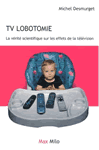
You will certainly find it worthwhile to read the eye-opening book by Michel Desmurget (doctor in neuroscience) entitled “TV LOBOTOMIE – La vérité scientifique sur les effets de la télévision” (TV Lobotomy — the scientific truth about the effects of television, in French).
Here is a brief excerpt from the presentation on the back cover (our translation):
“Every month, international scientific journals publish dozens of results of this kind. For specialists, of whom the author is one, there is no longer any doubt: television is a scourge. It exerts a profoundly negative influence on intellectual development, school results, language, attention, imagination, creativity, violence, sleep, smoking, alcoholism, sexuality, body image, eating behaviour, obesity and life expectancy.
These facts are denied with fascinating aplomb by the audiovisual industry and its army of accommodating experts. The strategy is not new: the tobacco companies used it, in their day, to dispute the carcinogenic nature of tobacco…”
The book ends with a vast bibliography listing the hundreds of scientific studies on which the author’s reflections are based.